

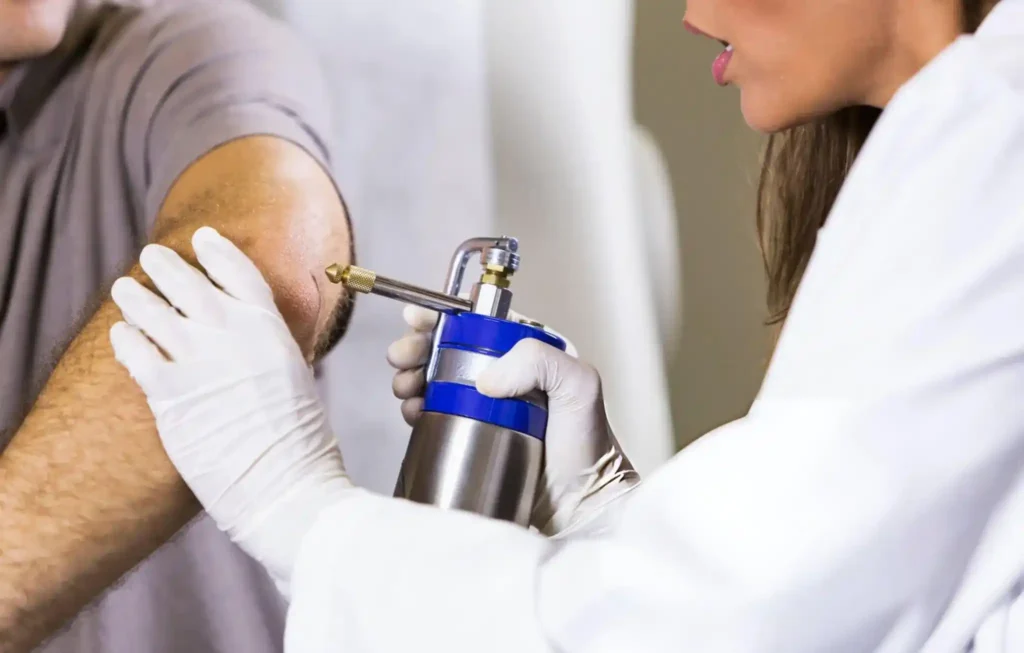
If you have been told that a skin lesion may be suitable for cryotherapy, or you are trying to understand what liquid nitrogen treatment involves, this article explains the procedure clearly. It covers what skin cryotherapy is, why a lesion needs to be assessed first, what happens during treatment, and how the area may heal afterwards.
This article is about medical cryotherapy for surface skin lesions. It does not cover whole-body cryotherapy chambers, sports recovery treatments, or fat freezing.
Key Takeaways
- Skin cryotherapy uses controlled extreme cold, commonly liquid nitrogen, to freeze selected surface lesions following clinical assessment.
- A lesion should be examined before freezing because another procedure, pathology testing or referral may be more appropriate.
- Redness, tenderness, blistering or scabbing may occur during healing, but worsening or unusual changes should be reviewed by a GP.
How Does Cryotherapy Work on a Skin Lesion?
Skin cryotherapy is a procedure that uses controlled extreme cold, commonly liquid nitrogen, to freeze selected superficial skin tissue. The freezing damages the treated tissue, which then heals gradually over the following days or weeks.
Liquid nitrogen is applied to the lesion using a spray device or a cotton swab. The freezing process can cause a brief stinging or burning sensation. The treated area then thaws, and the healing process begins. Whether cryotherapy is suitable depends on the type, location, size, and clinical assessment of the lesion.
What Types of Skin Lesions May Be Treated With Cryotherapy?
Cryotherapy may be considered for selected superficial skin lesions where the diagnosis has been established. Examples where it is sometimes used include:
- Selected viral warts
- Actinic keratoses, also called solar keratoses or sun-damaged spots
- Selected seborrhoeic keratoses
- Certain other superficial benign lesions
Suitability varies between patients and lesions. The appropriate approach depends on the diagnosis, location, size and depth of the lesion, as well as individual clinical factors.
Why Must a Skin Lesion Be Assessed Before Freezing?
Not every skin lesion is suitable for cryotherapy. A new, changing, pigmented, or uncertain lesion needs clinical examination before any destructive treatment is used. In some cases, another approach may be more appropriate.
A GP may recommend monitoring, a biopsy, a shave or punch procedure, excision, or specialist referral instead of cryotherapy. This is particularly important when the diagnosis is uncertain, because cryotherapy destroys tissue rather than preserving it for pathology testing.
Patients can also read DermNet’s cryotherapy information for an overview of common uses, risks and aftercare.
A new, changing, or uncertain skin lesion should be assessed before treatment. A GP skin assessment can help determine whether cryotherapy, another minor procedure or referral may be appropriate.
What Happens During a Cryotherapy Procedure?
Cryotherapy is often a brief procedure and may be performed in general practice when clinically appropriate. A typical appointment may follow these steps:
- The GP examines the lesion and discusses treatment options with the patient
- The treatment area is prepared where clinically appropriate
- Controlled cold is applied to the selected lesion using an appropriate technique
- The treated area thaws and the patient receives aftercare instructions
Patients usually experience stinging, burning, or pressure during and shortly after the application. The intensity varies depending on the location, lesion, and treatment depth. Treatment duration and technique depend on clinical judgement rather than a fixed schedule.
What Can You Expect While the Area Heals?
Healing can vary depending on the lesion type, treatment site, depth of freezing, and individual response. Some expected changes in the days following treatment include:
- Temporary redness, swelling and tenderness
- A clear or blood-filled blister may develop
- The blister gradually dries and a scab or crust forms
- The scab separates over time, and the area heals underneath
- Temporary or longer-term colour change may occur, particularly a lighter patch
Not every treated area blisters, and healing is not identical for everyone. Body areas such as the legs may heal more slowly than the face.
Cryotherapy Aftercare: How Should You Care for the Area?
Follow the instructions provided by your treating GP or clinician, as their specific advice takes priority. General aftercare guidance may include:
- Keep the area clean using the gentle method recommended after treatment
- Do not deliberately break or pierce a blister
- Use a dressing if advised, or if clothing rubs against the treated area
- Avoid applying antiseptics, creams or other products without clinical advice
- Avoid picking at scabs as the area heals
- Protect the healed skin from sun exposure once it has recovered
What Are the Possible Risks and When Should You Contact a GP?
Cryotherapy can produce temporary skin changes that are part of normal healing. There are also possible risks including scarring, pigment change and incomplete response or recurrence of the lesion.
| Changes that may occur during healing | Contact your GP or clinician if |
| Mild redness or swelling | Redness continues to spread |
| Tenderness or stinging | Pain or swelling is increasing |
| A clear or blood-filled blister | There is pus or thick discharge |
| Scabbing or crusting | Bleeding does not settle |
| Temporary skin colour change | The area is not healing as expected |
| The lesion persists, returns or changes. | The lesion persists, returns or changes |
Infection may present as increasing pain, warmth, spreading redness or discharge. If you are unsure whether a change is expected, contact the treating clinician for advice.
Cryotherapy for Selected Skin Lesions in Branxton
Branxton Healthcare may provide cryotherapy for selected skin lesions following assessment by a GP. In some situations, another minor procedure or referral to a specialist may be recommended instead. Procedure fees may differ from standard consultation billing, so patients are encouraged to ask about fees and billing information when booking.
You can contact Branxton Healthcare to arrange a skin consultation and discuss the most appropriate appointment type.
FAQs
Does cryotherapy hurt?
Most patients feel stinging, burning or pressure during and shortly after the application of liquid nitrogen. The level of discomfort varies depending on the location, size and depth of treatment.
Is it normal to get a blister after cryotherapy?
A clear or blood-filled blister may develop after treatment. A clear or blood-filled blister can be an expected response after cryotherapy. Do not deliberately break it, and contact the treating clinician if pain, redness, swelling or discharge is increasing. Follow your clinician’s instructions about whether to cover it or leave it alone.
How long does cryotherapy take to heal?
Healing time varies depending on the lesion, treatment site, freeze depth and individual skin response. Healing time varies depending on the lesion, treatment site, freezing depth and individual skin response. Areas such as the lower legs may take longer to heal than the face.
Will one treatment be enough?
Some lesions respond after a single treatment, while others may require a follow-up review or repeat treatment. Your GP will advise based on the lesion’s appearance and response.
Can every skin lesion be treated with cryotherapy?
No. A lesion should be identified before treatment. Suspicious, changing or uncertain lesions—and lesions requiring tissue for pathology—may need biopsy, excision or referral instead.
References and Resources
RACGP (2017) Optimising cryosurgery technique, Australian Family Physician, RACGP website, accessed 27 June 2026.
DermNet (2023) Cryotherapy: uses, cautions and aftercare, DermNet website, accessed 27 June 2026.
Memorial Sloan Kettering Cancer Centre (2022), Cryotherapy for Skin Lesions, MSK website, accessed 3 August 2026.
Healthdirect Australia (2024) Skin cancer and melanomas, Healthdirect website, accessed 27 June 2026.