

If you have a persistent cough, wheeze, or breathlessness, a GP may sometimes recommend spirometry to assess how well air moves through your lungs. Someone may also be reading this because a spirometry appointment has already been arranged and they want to know what to expect.
This article explains what a spirometry test measures, what happens during the test, what FEV1 and FVC mean, and what the results can and cannot show.
Key Takeaways
- Spirometry measures how much air you can forcefully breathe out and how quickly you can exhale it.
- Key measurements include FEV1, FVC and the FEV1/FVC ratio, which help clinicians recognise patterns of airflow.
- Spirometry can support assessment of conditions such as asthma and COPD, but results must be interpreted alongside symptoms, history and test quality.
What Is a Spirometry Test?
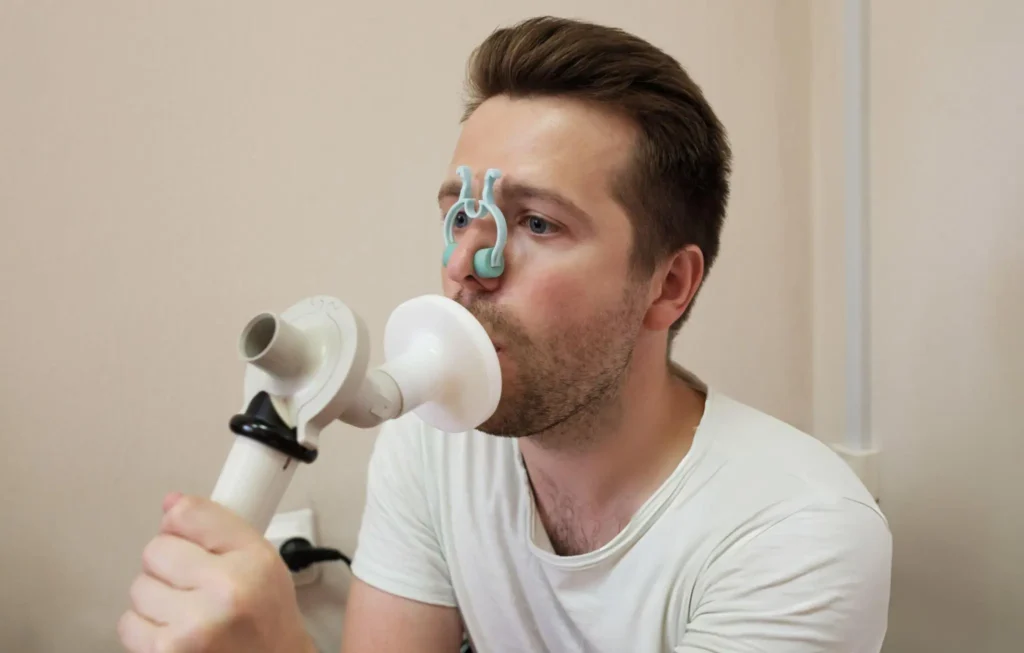
A spirometry test is a lung function test that measures how much air you can forcefully breathe out and how quickly you can exhale it, using a device called a spirometer. You breathe through a mouthpiece and perform several strong, controlled breathing efforts while the device records the measurements.
Spirometry is one of the most established lung function tests available and is commonly used when a GP is investigating breathing symptoms or monitoring a respiratory condition.
Why Might a GP Recommend Spirometry?
A GP may consider or arrange spirometry when assessing persistent cough, wheezing, breathlessness, chest tightness, or reduced exercise tolerance. It may also be considered when asthma or COPD is suspected, or when monitoring lung function in someone with an established respiratory condition.
These symptoms can have several causes, so spirometry is one part of the assessment rather than a stand-alone answer. A GP considers your symptoms, history, and other clinical information alongside the result.
If you have an ongoing cough, wheeze or breathlessness, a GP assessment for ongoing breathing symptoms can help determine whether spirometry or another investigation may be appropriate.
How Should You Prepare for a Spirometry Test?
The testing provider will give you specific instructions before your appointment. These take priority over general preparation advice because preparation depends on the clinical purpose of the test.
General points to keep in mind include:
- Tell the testing provider which inhalers and medicines you currently use.
- Do not stop prescribed respiratory medicines unless specifically told to do so.
- Wear comfortable clothing that allows you to breathe deeply.
- Also tell the testing provider about any recent surgery, pneumothorax, coughing up blood, significant heart problems or other recent health changes that could affect testing.
Do not stop any inhaler on your own. Withholding instructions, where they apply, are given by the clinician arranging the test.
What Happens During a Spirometry Test?
Spirometry is non-invasive, but it does require effort. Forceful breathing can temporarily cause coughing, light-headedness or breathlessness in some people.
The test typically follows these steps:
- The operator explains the breathing technique and demonstrates what is expected
- You take a full breath in as deeply as possible
- You seal your lips firmly around the mouthpiece
- You blow out as hard and fast as possible for as long as instructed
- The effort is repeated several times to obtain consistent, technically acceptable measurements
Repeating the manoeuvre does not mean something is wrong. Several good-quality attempts may be needed so the measurements are consistent enough to interpret reliably.
In some situations, spirometry is repeated after a bronchodilator to assess whether airflow measurements change after medicine that relaxes and widens the airways. This is particularly relevant when asthma or another obstructive condition is being investigated. For more on spirometry in the context of childhood asthma, see our article on spirometry in childhood asthma assessment.
What Do FEV1, FVC and the FEV1/FVC Ratio Mean?
| Measurement | What it means |
| FEV1 | How much air you can forcefully breathe out during the first second |
| FVC | The total amount of air you can forcefully breathe out after a full breath |
| FEV1/FVC ratio | The proportion of your total forced breath that leaves during the first second |
These are the core measurements used when interpreting spirometry results. The measurements are compared with appropriate reference values based on personal characteristics such as age, height and sex, then interpreted alongside test quality and the clinical situation. Interpreting these figures is a clinical task and should not be done from a single number alone.
What Can Spirometry Results Show?
Spirometry results can provide important information about airflow, but they are interpreted alongside symptoms and clinical history rather than read in isolation.
Results may show:
- An airflow obstruction pattern: A reduced FEV1/FVC ratio can indicate that air is leaving the lungs more slowly than expected, which may occur in conditions such as asthma and COPD
- Bronchodilator responsiveness: A meaningful improvement in measurements after bronchodilator use can provide evidence of variable airflow limitation and may support an asthma assessment when the clinical history is consistent
- A possible restrictive pattern: A reduced FVC with a normal or increased FEV1/FVC ratio may suggest a restrictive pattern. Spirometry cannot confirm restrictive lung disease on its own; lung-volume testing is needed for confirmation.
- Whether further assessment may be useful: Unexpected, incomplete or technically limited results may point toward repeat testing or further respiratory assessment.
For more patient information about breathing tests, see Lung Foundation Australia’s guide to lung function testing.
Can Spirometry Help Diagnose Asthma or COPD?
Spirometry plays a different role in asthma and COPD assessment.
For asthma, spirometry is an important objective test when the condition is suspected. However, normal spirometry does not always rule out asthma, particularly if symptoms are not active during testing. A GP considers whether airflow changes over time or after bronchodilator treatment alongside the broader clinical picture.
For COPD, post-bronchodilator spirometry is used to confirm persistent airflow obstruction. The result is interpreted alongside symptoms, relevant exposure history and the broader clinical assessment. It is interpreted together with symptom history, relevant exposure history such as smoking, and clinical assessment.
What Happens After a Spirometry Test?
The result should be reviewed by the health professional who arranged the test. They will consider the spirometry findings alongside your symptoms, medical history and the quality of the test itself.
Next steps may include no further testing, a repeat spirometry, additional lung function assessment, a treatment review, or a referral to a respiratory specialist where clinically appropriate. If you have an established respiratory condition such as asthma or COPD, ongoing care for asthma and COPD can support regular monitoring and follow-up.
Respiratory Symptoms and GP Care in Branxton
Branxton Healthcare provides general practice care for patients with respiratory symptoms and chronic conditions. Adults with persistent cough, wheeze or breathlessness can speak with a GP about their symptoms and whether spirometry or another investigation may be appropriate as part of their assessment.
You can book a GP appointment to discuss your symptoms and suitable next steps.
FAQs:
Does a spirometry test hurt?
Spirometry is non-invasive, but forceful repeated breathing can temporarily cause coughing, light-headedness or breathlessness in some people. The person conducting the test can pause if needed.
Can spirometry diagnose asthma?
Spirometry can provide important evidence when asthma is suspected, particularly if variable airflow limitation is demonstrated. However, normal spirometry does not always exclude asthma, and the result is considered alongside symptoms and clinical history.
Can you have normal spirometry and still have asthma?
Yes. Lung function can appear normal when asthma symptoms are not active at the time of testing. A GP may consider repeat or additional testing depending on the overall clinical picture.
Why might spirometry be repeated after using an inhaler?
The repeat test checks whether airflow measurements change after medicine is used to open the airways. This bronchodilator responsiveness test can provide useful information when asthma or another obstructive condition is being assessed.
References and Resources
Thoracic Society of Australia and New Zealand – Spirometry Resources
Australian Asthma Handbook – Lung Function Tests
Australian Asthma Handbook – Diagnosing Asthma in Adults and Adolescents
Lung Foundation Australia – How Does a Lung Function Test Work?